Public Transport vs. Car Cost Comparison: Find the Cheaper Option
A car costs far more than the fuel you put in it. Once you add insurance, repairs, parking, registration, and the value the car loses each year, the true monthly figure often lands two to four times higher than most drivers expect. A transit pass, by contrast, is one predictable number you can see on a statement.

That gap is why a proper public transport vs car cost comparison changes household budgets so quickly. For most people living within reach of a reliable transit line, going car-free or dropping to one shared vehicle frees up the single largest slice of spending after housing.
The catch is that transit only wins when the routes match your life. A commute that takes 25 minutes by car and 80 minutes by bus carries a real cost in lost hours, and that cost belongs in your math alongside fuel and insurance.
Key Takeaways
- Count every ownership cost, not just fuel, before comparing a car to a transit pass.
- Transit almost always wins on price in dense areas; distance and poor service flip the result.
- A mixed setup, transit for commuting plus occasional rideshare or car rental, often beats both extremes.
What Does Each Option Really Cost?
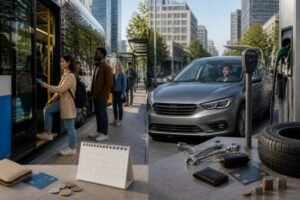
Car costs split into fixed charges you pay whether you drive or not (loan payment, insurance, registration, depreciation) and variable charges tied to distance (fuel, tires, maintenance). Transit costs sit almost entirely in a monthly pass, plus a few extra trips the pass does not cover.
How to Calculate the Full Monthly Cost of Driving
Add these together and divide by 12 where the bill is annual:
- Car payment or loan payment on the vehicle
- Depreciation if you own it outright: the value the car loses per year, which is steepest on a new car
- Insurance premium
- Fuel cost: your monthly distance divided by your mpg or efficiency figure, times the current gas price
- Maintenance: oil changes, tires, brakes, plus a repair fund
- Registration fees and taxes
- Parking fees at home and work, including monthly parking
- Tolls on your regular route
An electric vehicle trims fuel and some maintenance, though the payment, insurance, and depreciation lines stay.
What Does Public Transit Cost Beyond a Monthly Pass?
The pass cost covers your bus, train, and subway trips. Real spending sits a little above it.
Budget for the trips transit cannot handle: a rideshare home after a late shift, taxis in bad weather, a scooter for the last mile, or a weekend car rental for a trip out of town. Car-share services like Zipcar charge by the hour, which suits a monthly grocery run or a furniture pickup.
Most car-free households spend a modest amount on these extras each month. Even a generous allowance stays well under one car insurance premium.
A Simple Transit vs. Car Calculator Formula
Use one line for each side:
Car total = payment + insurance ÷ 12 + registration ÷ 12 + (miles ÷ mpg × fuel price) + maintenance fund + parking + tolls + depreciation ÷ 12
Transit total = monthly pass + rideshare budget + car rental or car-share budget
Subtract the smaller from the larger. That difference is what one option frees up every month.
How to Compare Costs Over a Realistic Comparison Period
One month hides the expensive parts of car ownership. Tires, a timing belt, or a transmission repair arrive on a multi-year cycle, so a 12-month comparison period is the shortest that tells the truth, and 36 months is better.
Pull your last three years of car spending from bank statements, total it, and divide by the number of months. Compare that figure to three years of pass payments plus extras.
When Is Transit or Driving the Better Value?
Transit wins on price in dense urban areas with frequent service, and driving wins on cost per useful hour in rural areas or anywhere a trip means several transfers. Population density, service frequency, and parking prices decide which side of that line you sit on.
Factor | Public Transport | Car Ownership |
Typical monthly cost | One pass + small extras | Payment, insurance, fuel, upkeep |
Best location | Dense urban areas | Rural and low-density areas |
Door-to-door speed | Slower with transfers | Faster off-peak |
Cost when unused | Skip a month, pay nothing | Fixed costs continue |
Carbon footprint per rider | Lower | Higher |
Late-night flexibility | Limited service hours | Full |
How Location Changes the Break-Even Point
In a city with high monthly parking and heavy traffic congestion, a car can cost several hundred a month before you drive anywhere. A pass replaces all of it, and walking covers short trips.
Outside those areas, the math flips. Long distances, no nearby stop, and hourly service push the effective cost of transit well past the price of a used car with cheap insurance.
Check the walking time to your nearest stop and the frequency at the hours you travel. Anything beyond a 12-minute walk or a 30-minute gap between services weakens the case for going car-free.
Does a Faster Commute Justify Higher Car Costs?
Put a value on your time and the comparison sharpens. Multiply the extra minutes transit adds each way by 20 workdays, then divide the monthly car premium by those hours.
If driving costs 300 more per month and saves 20 hours, you are paying 15 an hour to skip the bus. Decide whether that rate beats what your time earns or what the ride is worth to you.
Transit hours are not fully lost. Reading, work email, or rest on a train has value that a driver’s seat does not offer, and that shifts the calculation for many riders.
How to Build a Lower-Cost Transit-First Lifestyle
Choose housing near a high-frequency line before anything else. Rent a bit higher near a stop still beats a longer commute plus full car ownership in most cities.
A few habits keep the costs down:
- Buy the pass tier that matches your real trip count; occasional riders often overpay for unlimited
- Combine errands into one outing along a single route
- Keep a folding bike or scooter for last-mile gaps
- Set a fixed monthly cap for rideshares so convenience does not erode the savings
The American Public Transportation Association tracks ridership and service data if you want to check how well your area is served.
When a Hybrid Approach Makes More Sense Than Going Car-Free
Keeping one modest car for a two-adult household, with transit covering daily commuting, usually costs less than two vehicles and less than a fully car-free setup that leans on rideshares.
Run the numbers on the second car specifically. Its payment, insurance, and depreciation are pure additions, while the trips it covers might fit into a weekend rental or a car-share booking.
Households in mid-density suburbs often land here: transit for the weekday commute, one shared car for groceries, medical appointments, and travel outside the service area. Track which trips the car handles for a month, then price those exact trips through other options before renewing insurance.