Car Ownership Hidden Costs Breakdown: What You Really Pay
The sticker price on a car is the smallest part of what you pay. Once you add the money that leaves your account every month and the value your car quietly loses while it sits parked, the real number often lands at two to three times what most drivers expect.
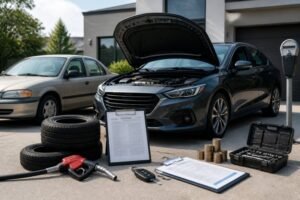
A useful car ownership hidden costs breakdown includes seven buckets: depreciation, loan interest, insurance, fuel or charging, maintenance and repairs, taxes and registration, and daily costs like parking and tolls. Miss any one of them and your budget will be short.
Depreciation is the one most people skip, because no bill ever arrives for it. Yet on a new car, it frequently costs more per month than the loan payment during the first few years.
The good news is that a large share of these expenses respond to your choices. The vehicle you pick, the loan term you accept, and how you handle service all move the total by real money each year.
Key Takeaways
- Your true cost of car ownership includes value lost over time, not just payments and fuel.
- Depreciation, interest, and insurance are set mostly at the moment you buy.
- Smart vehicle choice and steady maintenance cut yearly car expenses more than any single trick.
How to Calculate Your Real Cost to Own a Car

Add every dollar the car pulls from you in a year, then divide by twelve. That figure covers the purchase price spread over your ownership period, lost resale value, financing costs, insurance premiums, fuel, taxes and registration fees, and the small costs like parking that never show up in a car ad.
Start With the Out-the-Door Purchase Cost
The out-the-door price is what you sign for after sales tax, registration fees, documentation charges, and any dealer add-ons get stacked onto the negotiated number.
That total often runs 8% to 12% above the advertised price. It also becomes the base for your loan, so every extra dollar there earns interest for years.
Ask for a written out-the-door quote before you agree to anything. Line items for paint protection, fabric coating, or nitrogen-filled tires are removable.
Why Depreciation Can Cost More Than Your Monthly Payment
Depreciation is the gap between what you paid and what your car is worth when you sell it, and it is the largest single cost of owning a car for most new-vehicle buyers.
A typical new car loses roughly 20% of its value in the first year and about 40% to 50% by year five. On a $35,000 car, first-year depreciation alone can exceed $7,000, or nearly $585 a month.
Used cars sidestep the steepest part of that curve. Buying a well-kept vehicle that is two to four years old lets the first owner absorb the largest drop while you still get most of the useful life.
Resale value varies widely by model. Two cars with the same new car price can differ by $6,000 or more in what they fetch after five years.
How Loan Terms, APR, and Down Payment Affect Total Interest
A longer loan term lowers your payment and raises the total you pay. Stretching a car loan from 48 to 84 months can add thousands in auto loan interest on the same amount borrowed.
Here is how the math moves on a $30,000 balance at 7% APR:
Loan term | Monthly payment | Total interest |
48 months | $718 | $4,478 |
60 months | $594 | $5,644 |
72 months | $511 | $6,829 |
84 months | $453 | $8,034 |
Your credit score sets the APR, and the spread between strong and weak credit often runs 6 to 10 percentage points. A larger down payment cuts both the interest and the risk of owing more than the car is worth.
Run the numbers through a loan calculator before you sit down at a dealership. Decide on a maximum total interest figure, then work backward to a term and price.
How Much Do Insurance Premiums Add Each Year?
Full coverage auto insurance averages roughly $2,000 to $2,600 a year for U.S. drivers, or $165 to $215 a month. Liability-only policies run closer to $600 to $800.
Auto insurance rates swing hard on your ZIP code, driving record, age, and the car itself. Sports models and vehicles with costly repair parts carry premiums well above a mid-size sedan.
Get quotes on your top two or three models before you buy. The difference between them can reach $700 a year, which is real money over a five-year hold.
Raising your deductible from $500 to $1,000 trims premiums by roughly 10% to 15%, provided you keep that cash available.
Estimate Fuel Costs From Mileage, MPG, and Gas Prices
Use this formula: annual miles ÷ MPG × price per gallon.
At 12,000 miles a year and $3.30 per gallon, a 25 MPG vehicle burns about $1,584 in fuel. Move to a 35 MPG car and the bill drops to $1,131, saving $453 a year.
Fuel economy gaps widen with your commute. Someone driving 20,000 miles a year sees roughly $750 in annual savings from that same 10 MPG improvement.
Check the combined city and highway rating rather than the highway number, since most driving mixes both.
Include Taxes, Registration Fees, Parking Costs, and Tolls
These smaller line items add $500 to $2,500 a year depending on where you live and park.
- Sales tax: charged once at purchase, commonly 4% to 8% of the price
- Registration and title fees: $50 to $600 annually, sometimes tied to vehicle value
- Property tax on vehicles: applies in some states and can run several hundred dollars
- Parking: monthly garage or permit costs in cities frequently exceed $200
- Tolls: a daily toll route at $6 round trip totals about $1,500 a year
- Emissions or safety inspection: $20 to $80 in states that require it
Turn Annual Expenses Into a Monthly Car Budget
Total your yearly figures, divide by twelve, and treat the result as a fixed line in your budget.
A sample for a five-year-old mid-size sedan driven 12,000 miles a year:
Expense | Annual | Monthly |
Depreciation | $2,400 | $200 |
Loan interest | $900 | $75 |
Insurance | $1,800 | $150 |
Fuel | $1,400 | $117 |
Maintenance and repairs | $900 | $75 |
Taxes, registration, parking | $700 | $58 |
Total | $8,100 | $675 |
Set aside the maintenance and repair portion in a separate savings account each month. When a $1,200 repair lands, the money already exists.
Lower the Costs You Can Control
Vehicle choice, service habits, and driving patterns are the three areas where your decisions change the yearly total by thousands. Depreciation and insurance get locked in the day you buy, while maintenance and fuel respond to what you do every month after that.
Choose a Vehicle With Lower Long-Term Ownership Costs
Reliability rankings track closely with total cost of ownership, and models from Toyota, Honda, and Subaru have held that advantage for years.
Vehicle class drives the spread more than any single badge:
Class | Typical 5-year cost | Main cost driver |
Compact car | Lowest | Cheap parts, high MPG |
Mid-size sedan | Low | Strong resale, moderate insurance |
Compact SUV | Moderate | Higher fuel use, larger tires |
Full-size truck | High | Fuel, tires, insurance |
Luxury sedan or luxury SUV | Highest | Steep depreciation, dealer-only parts |
A Toyota Camry and a comparably priced BMW or Audi sedan can differ by $15,000 or more across five years, mostly through resale value and repair bills. Hyundai has closed much of the reliability gap while pricing below several competitors.
Check the cost of a common repair before buying. A water pump on a mainstream car might run $500; the same job on a luxury model can triple that.
Budget for Scheduled Maintenance and Unexpected Repairs
Plan on $100 to $150 a month for maintenance and repairs on a vehicle past its warranty period.
Scheduled service follows the maintenance schedule in your owner’s manual, not the dealer’s upsell sheet. Oil changes, filters, and fluid checks land at predictable intervals and predictable prices.
Bigger items arrive on their own timeline. Timing belts, water pumps, alternators, and suspension parts show up between 60,000 and 120,000 miles on many vehicles.
Keep service records. A documented history raises resale value and helps a mechanic diagnose problems faster.
Factor In Tires, Brakes, Wipers, and Fluids
Wear items add roughly $400 to $700 a year on average, spread unevenly across the calendar.
- Tires: $600 to $1,200 per set, replaced every 40,000 to 60,000 miles
- Brake pads and rotors: $300 to $700 per axle, every 30,000 to 70,000 miles
- Wiper blades: $25 to $60 a pair, once a year
- Fluids: brake fluid, coolant, and transmission fluid services run $80 to $300 each
Larger wheels cost more to shoe. A 20-inch performance tire can cost double a 16-inch all-season, and that gap repeats every replacement cycle.
Rotate tires every 5,000 to 8,000 miles and check pressure monthly. Both extend tread life and improve fuel efficiency.
Compare Electric Vehicles With Gas Cars Before You Buy
Electric vehicles cut fuel and maintenance spending while carrying higher purchase prices and steeper early depreciation on many models.
Factor | Electric vehicle | Gas car |
Fuel or energy per year | $500 to $700 | $1,300 to $1,800 |
Routine maintenance | Lower (no oil, fewer parts) | Higher |
Purchase price | Higher | Lower |
Insurance premiums | Higher on average | Lower |
Home charging setup | $800 to $2,200 for Level 2 | None |
Your electricity rates decide much of the math. Charging at home overnight on an off-peak rate costs a fraction of public fast charging, which sometimes approaches gasoline pricing per mile.
Home Level 2 charging is close to essential if you drive more than 30 miles a day. Without it, the convenience advantage shrinks fast.
Brake pads last far longer on EVs because regenerative braking does most of the slowing.
When an Extended Warranty May or May Not Be Worth It
An extended warranty pays off when you keep a vehicle with a weak repair record past 100,000 miles and cannot absorb a $3,000 bill.
Coverage commonly costs $1,500 to $3,500 upfront, and a portion of that goes to the seller as commission. On a reliable model, that money outperforms the warranty when parked in a repair savings fund.
Read what the contract excludes. Wear items, maintenance, and pre-existing conditions sit outside most plans, and some require service at specific shops.
Manufacturer-backed plans priced at purchase are negotiable, and third-party offers arriving by mail deserve the same scrutiny as any other sales pitch.
Cut Driving Costs Without Replacing Your Car
Reducing miles driven lowers fuel, wear, and sometimes insurance in one move.
- Combine errands into a single trip, since a cold engine burns more fuel in the first few miles
- Carpooling two days a week cuts commute fuel by roughly 40%
- Keep tires at the pressure listed on the driver’s door jamb, worth about 3% in fuel economy
- Remove roof racks and heavy cargo when not in use
- Ask your insurance provider about low-mileage or telematics discounts if you drive under 8,000 miles a year
- Handle air filters, wiper blades, and cabin filters yourself, which takes minutes and saves shop labor
Steady speeds help more than most drivers expect. Hard acceleration and heavy braking can cut fuel economy by 15% to 30% in highway driving.